A Last Look
‘Learning from Each Other’ – since 1994
Amidst all the happy and exciting days we shared together in Shimna, standout days have always been the good news days for the school building. Working with governor David Maginn to find Murlough House to get started in, acquiring the Lawnfield site and building Shimna phase on phase, getting our place on the list for Fresh Start funding for our new building!
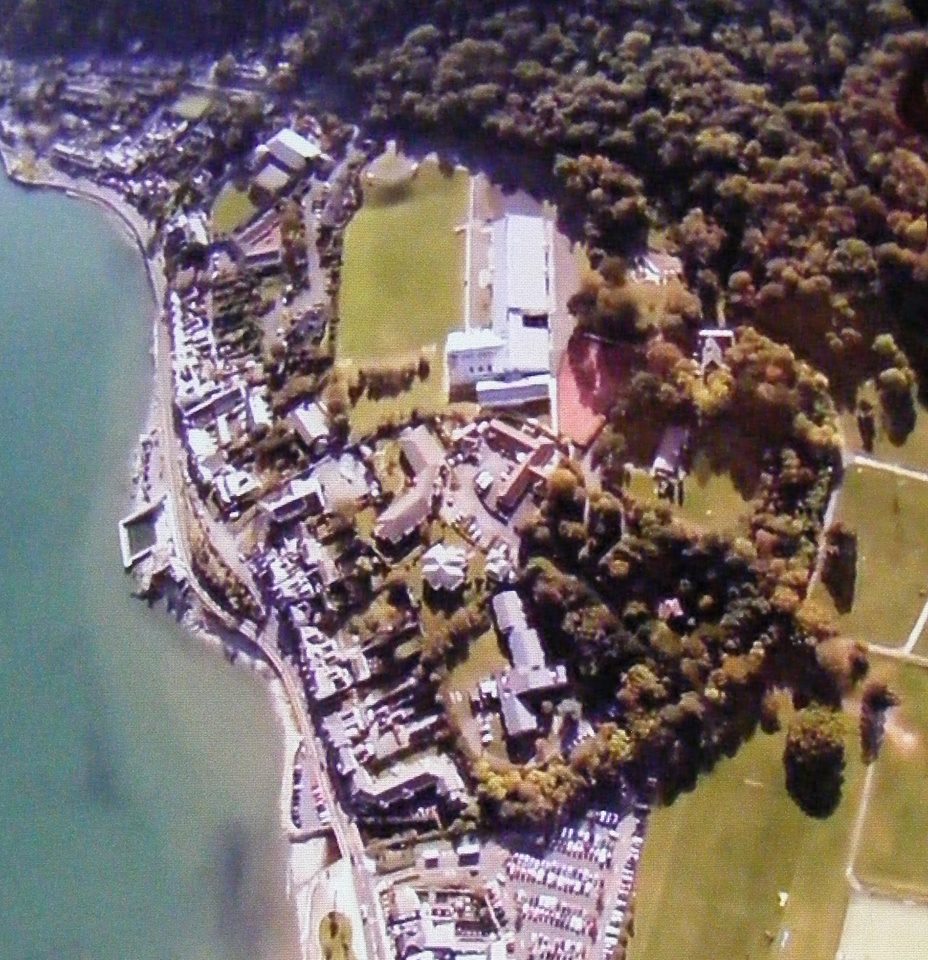
We remember all the scary, knife-edge decision moments, the unstinting support of the IEF and NICIE, and the huge effort and careful strategising that went into achieving each step forward. The most recent reminder came when a big chunk of Fresh Start money was pulled, and so many Integrated schools lost their opportunity for a new build, which was such a near miss for Shimna. Shimna hadn’t been anywhere near the top of the original Fresh Start list, but an early morning dash to a DE meeting in Antrim to present our carefully worked and detailed plans got us up there and saved us from the subsequent cull. Because our new building was well underway by the time the money was pulled for schools not already started, we had escaped by the skin of our teeth. It is wonderful that the new building is rising on our beautiful site, crucially right beside All Children’s IPS in its walled garden. But, then came the realisation that for the new building to open, the original building must be demolished.
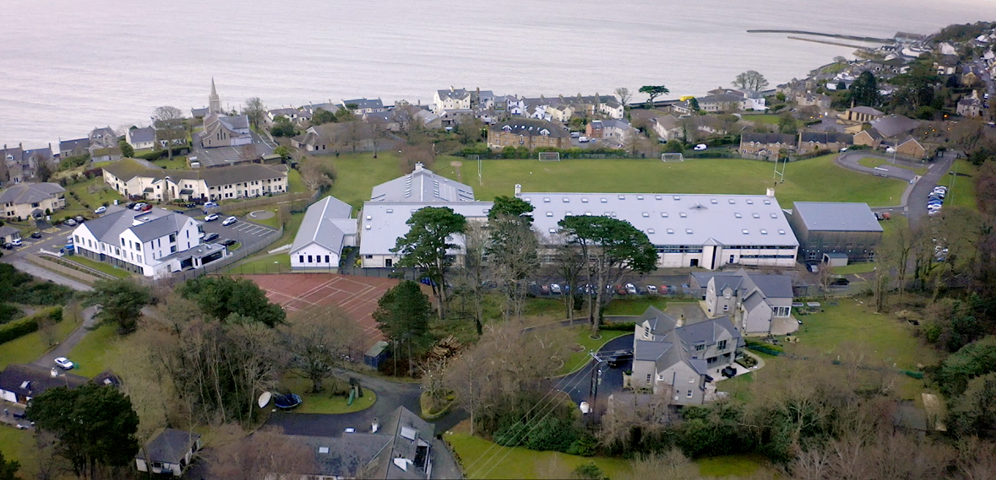
This is a Farewell Tour. Everything here will be familiar to different generations of Shimna students, staff, parents and governors and everyone will find some secret they didn’t know about.
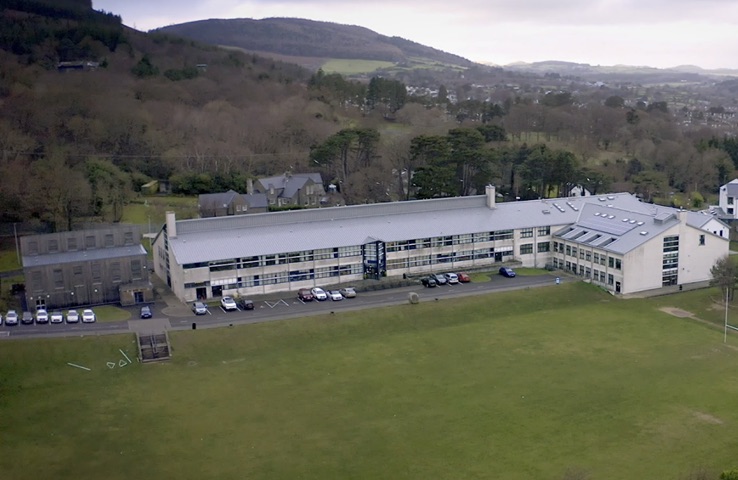
When we were in Murlough, of course we visited the Lawnfield building site very frequently, but we were particularly delighted that the first cohort of students and staff were able to move into the building in the last week of June 1995 and have the place to themselves before the second cohort and everyone else would arrive. When we made it to the Lawnfield, the basic framework of phase one was in place, and we had access to the office area, the science lab next door, the technology suite, the drama room and the assembly hall. Upstairs we had the rooms at the front of the building only, history, geography, a pretend home economics room with slots for cookers but no cookers, the library, Successmaker room (as it became) and the computer room. That was all. The assembly hall tripled as gym and dining hall. Every lunchtime, Careen Starkey and Joan Murray would drive up with the dinners and we would run out the tables into the gym and open up the serving hatches. Once dinner service was over, the tables were rushed away again to allow the next PE class to begin.
Mothers of students Brendan, Danielle, Alan and Siobhan had carried the desks and chairs from Murlough to the van and from the van into Shimna. Everyone had pulled their weight, and the school belonged to all of us. A small but ethos-affirming thing happened in the very first days after we had moved in with the founding students. Someone from the building team, unbeknownst to me, had put up a notice at the office area saying ‘No students beyond this point’. Morag took it down and presented it to me in the office, saying: ‘We were good enough to walk into your office in Murlough, and we are good enough to do it here’. I absolutely agreed with her, of course, and the notice never again saw the light of day, having been assigned to the bin.
The whole school was carpeted, promoting calm and comfort, and architect Arthur Acheson’s great wide corridors and plentiful natural light shining down through the carefully planned light wells, meant that while we were small and few in number, we could just sit down anywhere. Exhausted staff had a wee celebration at the end of that first week, and one of them bears a scar!
Arthur and I had planned attic spaces throughout the building for fitting out so the school could expand internally as we grew, without ever having to accept mobile, temporary accommodation which, despite its temporary designation, would have plagued us for years. And yes, the second cohort will remember a couple of truly dreadful mobiles with swelling doors which we had to rent for a short period of time while we made plans for phase two and worked on convincing the Department that those plans were achievable. That first summer the three languages rooms opened up, and the second summer the two maths rooms and the upstairs science lab were fitted out, the latter later becoming the business studies room. At that point we finally got a staffroom and a wee staff kitchen. Until then, we had all squeezed into the reprographics room at the office. Phase one of the building ended at outside doors just past technology, which led out onto a very rough space ready for building on. We had our wonderful Prunty pitch, which flooded less than any other pitch in Newcastle, and we had our horseshoe playground where the Sports Hall would eventually be built.
Then came the crunch point. Our vision for our building ran alongside our vision for a curriculum which would offer academic excellence in an all-ability context, and we needed to expand the building ahead of our students starting their GCSEs. We had the choice of four languages, additional maths, triple award science, English literature, ICT, technology, geography, history, art, media studies and music all ready to go, and they needed specialist accommodation. The Department of Education offered us a million pounds worth of mobiles, while we were still dreaming of Arthur’s innovative and clever phase 2 plans. Our hard bargaining, the enthusiasm of Glasgiven, and constant underwriting from the IEF meant that we pulled together a deal that got us a semi-permanent phase 2, with lots more secret spaces ready for further expansion.
Phase 2 would begin with science laboratories, art and music rooms, lovely spacious geography rooms, an Integrated and Religious Studies room, an English department, a canteen at last and some additional general classrooms. Those doors at technology became inside doors and led from phase 1 into phase 2. Phase 2 was probably a desperate sight to others, but we were delighted to have it. The walls were unpainted breeze block and the ceilings exposed enormous pipes and lots of wiring. I consoled myself that it was our version of the Pompidou centre which controversially made a virtue of exposing its functional innards. Fundraising, parental support and practical efforts from volunteers from BE Aerospace eventually put paint on the walls and, finally, with DE funding, put up ceilings. Full accessibility had to be fought for, and nobody would want to relive the struggle we had to ensure that a second lift was installed to serve phase 2, but we did it and it served our students and staff well.
Walking through phase 2 one day with Willian of Glasgiven, I asked what was behind the end wall. William guessed vacant space dug into the mountainside. He knocked a hole through and found the space which was to become the first sixth form common room. Those looking forward to state-of-the-art facilities in the new building can have no idea of the excitement as the underground, unventilated, windowless space became a frenzy of activity as our students painted the walls, the Parent Council provided carpet, Alicia Rooney ordered up lockers and a sort of ventilation fan was installed. The horrible room was an unexpected, additional treasure which holds a special place in the memories of early students. Various generations of snooker/pool tables and vending machines lived down there. In later years, Sinéad Rooney added tartan cushioned seating, Robbie Mulholland added wooden benches cannibalised from refurbished changing rooms and tables were repurposed from elsewhere. Recycled wooden panels fixed to metal frames made new tables when older ones died. Alicia ordered pink chairs so that staff couldn’t pinch them for their classrooms unnoticed! The common room also held a secret, known only to founder students, except in legend.
A casualty of our expanding sixth form was our library. Chair of governors and ex ETI inspector Billy Burnison, made it clear that a library without a librarian is a very underused facility and our 6th form needed their study space more. Ian McMillan, ever a font of creative solutions, declared that the school would become the library, our books were distributed out to our subject departments, and Ellen McVea sourced the funding for the English department to create and update classroom fiction and poetry book boxes.
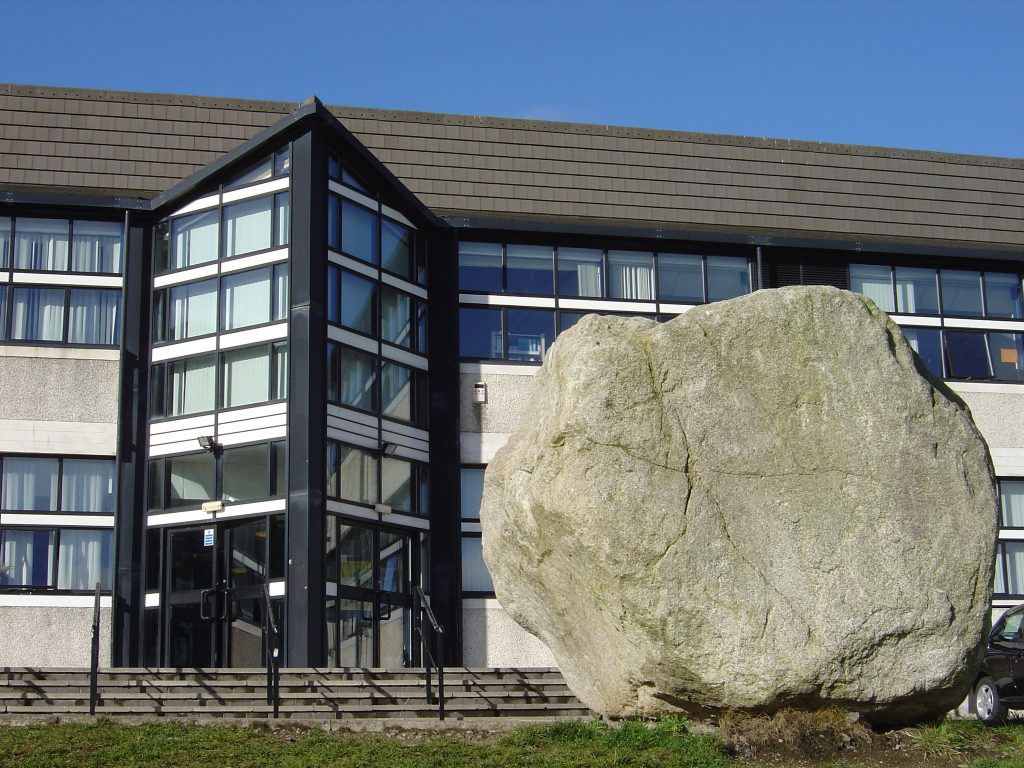
With phase 2 in place, we could focus some attention on our grounds. Glasgiven had unearthed a massive boulder when excavating for phase 2, and I adopted it as my Shimna metaphor. I hired a lorry and crane to move the boulder to the front of the school – a truly Sisyphean task in itself, and Deborah McDowell’s Stephen engraved the boulder with ‘Il faut imaginer Sisyphe heureux’, a quote from an Albert Camus philosophical essay and a nod to my existentialism. Shimna was founded by parents who questioned the status quo, who refused to believe in a pre-ordained path and who took control of what they could. On another level the boulder with its inscription was meant just to encourage people to stop and wonder.
Jean Forbes had joined us on the board of governors. She was an urban geographer and planner, and she set about working with students on a plan for the grounds to include an edible bird table, a grove of trees planted by students, parents, staff, governors and wee Lewis Koscielny one sunny Saturday. She also oversaw an eat-outery, daffodils and annual Woodland Trust tree planting. Mick Jordan and student Brian planted daffodils in a disconcerting straight line, successive form classes planted hazel, cherry, rowan, dogwood and birch around the perimeter and First Mourne Rainbows, Brownies and Guides joined in the planting once they came to meet at Shimna. Jo Rogers and the Student Council raised the money for the picnic tables for the eat-outery beside the canteen, which also served as an outdoor classroom. The Parent Council and Student Council united in raising funds for bus shelters. When Ellen began to offer horticulture GCSE, our visiting German student Nina inspired us to create a plastic bottle greenhouse with our Business in the Community volunteers who helped Public Services Diploma students Aaron, Cade, Ryan, Amy and Niall build the framework. Over the years, the plastic bottle greenhouse evolved and Robbie augmented it with pallets and recycled window panes and added two huge and well used compost bins. Generations of our Prince’s Trust groups painted and repainted the greenhouse and its wee window box, led by Joan McAllister and then Níamh Lindsay; Aidan McIlmurray built us raised beds; a lovely partnership with the Slieve Donard Hotel sent us Jilly Dougan to help us plan our edible garden, which over the years supplied the canteen and the summer veg stall. Mention must also be made of generations of litter pickers, Eco Warriors and various form classes, who kept our grounds in lovely order.
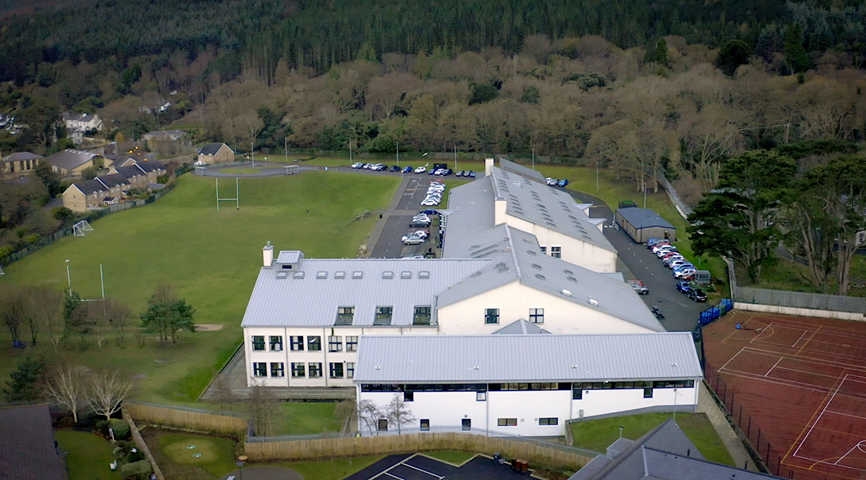
Our neighbours, All Children’s IPS, remained the school stuck in mobiles for longer than any other in Northern Ireland, but at last they got the go-ahead for their new building. All Children’s needed to decamp and we were delighted to house the mobiles provided for them by the Education and Library Board on our tennis court/netball/basketball area. Another, perhaps less welcome, legacy from this time, was our perimeter fence and big gates. Until then, our grounds had remained open to our neighbours in King Street for whom they had been a right of way into town. However, our efforts to avoid mobile classrooms were vindicated when the All Children’s mobiles attracted the first intruders we had ever had to deal with, and the Department of Education insisted on the fencing and gates.
Remember the not-very-good home economics room up beside the library? It later became Carmel Hannon’s room and then Ian McMillan’s. It really wasn’t fit for purpose, though I taught my after-school cooking club there, culminating in a wonderful celebratory banquet for parents, catered by the club students. The year that Shimna opened, home economics was disappearing from the NI curriculum, so facilities were not included in our first building. (Mysterious hanging plug points in the English room? Never noticed them!) When home economics teachers fought back and restored the subject to the NI curriculum, we were joined by the ever-resourceful Rebecca Murphy. She moved into the second art room and made do and mended with electric frying pans and blenders until the Department of Education agreed to provide us with fit for purpose facilities, and the plan for the Forbes Building took shape. As always, I did my utmost to plan and negotiate the best use of the space. With the support of the IEF, we turned what was to be a bleak, unused undercroft space into a lovely media studies room and much needed additional toilets.
As soon as we moved into phase 2 and the students started their GCSEs, I began negotiating for funds to fit out the phase 2 attics to be ready for the students’ A level and BTEC courses. Once again, the IEF came through, securing funding from the International Fund for Ireland, and we were able to fit out a mathematics department and accommodation for history and politics.
In 2006, and only after sterling work from Ellen, Grace Susay and the languages department, Shimna was successfully designated as NI’s first Specialist School for languages and the international dimension, bringing us very welcome funds for additional teaching, primary links and some money for capital improvements. At last we were able to open up the last two attic spaces, and James Magee’s lovely, airy computer room (initially Miguel’s Spanish room) with high ceilings and roof lights, was born from an unbelievably messy junk room which had looked like a huge, unfinished squash court. Into the scheme, we managed to incorporate work to the very strange L-shaped room opposite James’s room to add to the English department. In Noreen Salter’s time, we added daylight tubes, and eventually in Mairi McCurdy’s time, opening skylights, which made the room almost habitable. That room’s existence is testimony to every teacher’s urge to have a room of one’s own.
Shimna Stars Special Olympics Basketball Club trained in Shimna, and the small size of our only gym caught the attention of Minister of Education Caitríona Ruane when she called to visit the club one evening. She played a game along with the athletes, and recognised the limitations of our small gym. She had visited the school before and made clear her approval of our Integrated, all ability, academically excellent ethos and curriculum. The minister said before she left that she would see what she could do about our sports provision. The next summer, the horseshoe playground gave way to our much-appreciated sports hall. The sports hall enabled us to welcome even more community partners, and Newcastle Junior Athletics Club, in lieu of rent, built a very useful storage shed for us to share.
One wee building to tour in the imagination is Haughian House. Early in our Murlough days, we received a phone call from Oakland, CA. James Haughian, born just as his mother landed in California from the Mournes, had inherited a cottage just below Wee Binnian. He had been delighted to read about Shimna Integrated College in his postal subscription to the Mourne Observer and wanted to do a deal with us which would give our students use of the cottage in return for some housekeeping and repairs. Duke of Edinburgh’s Award groups and Public Services Diploma students spent many happy weekends there, constructive days and scary nights! Our thanks and thoughts to James (Jim) and his family.
Disasters did happen over the years, but we found a way to make the best of flood and fire. Once we flooded, with water up to the knees in the common room, RE and science labs. The flood had been the result of a freak accident on the Glen River, and the Department of Education invested in substantial flood prevention works, which, as a by-product and at our prompting, gave us our netball and tennis courts. When fire broke out in the staffroom kitchen, our fire safety infrastructure successfully confined the damage to two rooms. Pat Lenny’s business studies room had to be evacuated to recover from smoke damage, and was replaced by a mobile classroom in the courtyard below. When Pat’s room was habitable again, and the mobile classroom was to be removed, Robbie spotted yet another opportunity to add an additional space, and Shimna Integrated College Ltd. bought the mobile for the school.
The last stage of this farewell piece takes us to the additional accommodation we needed after the successful implementation of our Development Proposal to grow in line with the Department of Education’s new requirements for sustainable schools. The Department of Education agreed to provide us with an additional two classrooms in a separate small building. That building became the Croí, inhabited by the Integrated and Religious Studies department just at the perfect time when the department was shifting syllabuses to Philosophy and Ethics. Our now deeply ingrained habit of perusing the plans to exploit any opportunity for extra accommodation revealed the strange provision of ten tiny toilets in the space between the two classrooms. It turned out that the plans had originally been for a nursery unit, hence the tiny toilets. We arranged for them not to be supplied and John McCloskey had his wish for a quiet space for the department, which became both a quiet space and a very active, noisy space for our Amnesty International group to plan their actions and campaigns. The same space became another useful classroom in Covid times.
The story of our building is a story of repurposing for every curriculum change in order to ensure that we kept to the principle recommended to us by Aidan Hamill of NICEC when we opened: ‘offer only that in which you can give your students an excellent experience’, and to provide academic excellence for all our students in an all-ability school. We started with the NI statutory curriculum, we added academic options within the core subject areas, and, as syllabuses became more exclusive of some students, we added applied versions which would keep the full curriculum open to all. We found or we made the additional languages rooms, the additional computer rooms, the greenhouse, the horticulture store, additional laboratory space, 6th form study space, a quiet room etc. over and above the DE handbook and it took everyone’s effort to do it. We also transcended wonky walls, funny smells, redistributed lighting, exploding sewers, dodgy ventilation, grey walls, missing ceilings, inadequate canteen space etc. and our students and our staff richly deserve the brand new, state-of-the-art building. I achieved my aim of having the business case, the funding, the plans and the consultations all in place before I retired from Shimna. I congratulate everyone in Shimna for seeing the project through and reaching the day of moving in, and I wish everyone in Shimna every happiness and success in the new building.
Peace and love.
Kevin
Powered By EmbedPress